Executive Stress: What to Do in the Room
Most executive stress advice assumes you can step away. The board meeting doesn't. What holds when you have to stay in the room, composed.

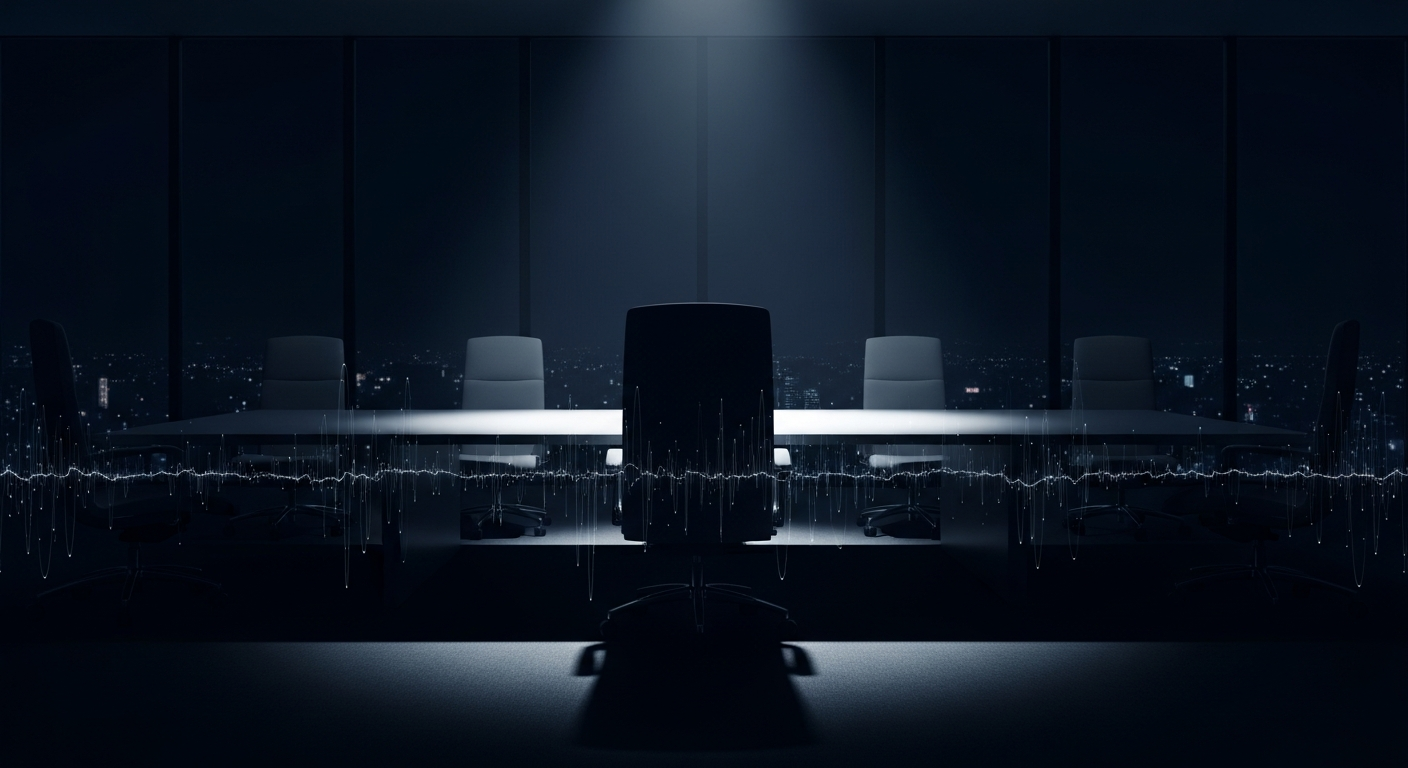
A board member once asked me, mid-meeting, why a number on slide nine didn't match the one in last quarter's deck. It was a fair question. The number was wrong, and the mistake was mine.
I felt the answer arrive in my body before my mind: heat up the neck, heartbeat in my ears, thoughts thinning out at the exact moment I needed them dense.
Most advice on executive stress management assumes you can step away. Take a walk, breathe somewhere quiet, return when you're level. But the defining feature of these moments is that you can't leave.
The board meeting, the hard conversation, the negotiation that turns — the room keeps going whether your nervous system cooperates or not.
Here is what I've learned about staying functional inside that room, including the part most advice skips: where the techniques stop working.
Executive Stress Hits the Body First
What happens in that moment isn't a discipline problem. It's chemistry.
Adrenaline lands in seconds. Heart rate climbs, breathing goes shallow, and blood shifts away from the parts of the brain that do your subtlest work. Your field of vision narrows, and your thinking narrows with it.
You reach for a name and it isn't there. You hear yourself answering faster than you're deciding. A question you could have handled over coffee suddenly reads as an attack.
I've watched brilliant people give their worst answers in exactly this state. The room rarely notices. The person remembers it for weeks.
None of this means you're fragile. This is standard-issue human hardware doing what it was built to do; the boardroom is the new part.
That's why "stay calm" is useless as an instruction. By the time you notice the flood, it has made its opening move. Nobody out-argues adrenaline; the way through is to give the body a different input.
The useful news: those inputs are physical, they're quiet, and no one across the table can see them.
The Two Handles You Can Pull Silently
Two physiological handles work from a chair, mid-meeting, with nobody noticing.
The first is your exhale. Breathe in normally, then push the exhale longer than the inhale: in for four counts, out for six or eight, through the nose.
A long exhale is the body's built-in brake. It slows the heart within a few breaths and tells the nervous system that whatever is happening, you are not in physical danger.
You can run it while someone else talks. From the outside, it reads as listening. I've run entire investor updates on that rhythm.
The second handle is grounding through attention. Press your feet into the floor and notice the pressure. Feel the pen's weight, the glass's temperature, the chair against your back.
Attention is bandwidth. Every unit you spend on something physical is a unit the threat loop doesn't get.
A variation that costs nothing: soften your gaze and take in the whole room instead of the face that rattled you. Narrow vision and narrow thinking travel together, and widening one loosens the other.
Then there's your voice. Under adrenaline you talk faster and pitch up. Cutting your pace in half does two things — it reads as authority, and it forces longer exhales without you thinking about breath at all.
None of this needs the room's permission. That's the point of choosing physiology over willpower: physiology works in public.
Managing Stress in the Room Starts Before You Walk In
The strongest in-room move is made in the hallway. Before any meeting with weight, I take two long-exhale breaths outside the door and settle one sentence: what my job in this room is.
"My job is to hear the concern fully before answering." "My job is to deliver the decision without softening it into confusion." A nervous system with one job spikes less than a nervous system braced for everything at once.
One sentence, chosen early, is the cheapest stress intervention I know. Mine, on the day of the wrong number, should have been: answer what I know, park what I don't. I walked in without one, and the flood found the gap.
The rest of the setup is unglamorous. Arrive early instead of sliding in hot from another call. Put the hard numbers on paper, so working memory isn't holding them when the flood tries to take working memory offline.
Skip the third coffee; adrenaline stacks on caffeine. And when you control the calendar, don't put two heavy rooms back to back — the second one inherits the residue of the first.
Composure is mostly preparation wearing a calm face. The operators I admire aren't unusually serene people. They've removed half their reasons to spike before the door ever opened.
When the Flood Wins Anyway
Here's the honest limit: mid-flood, self-deployed techniques often fail. They fail for a structural reason: running a technique requires the same clear-headedness the flood has taken offline.
You rarely notice you're spiking until you're deep in it. The trap of in-room stress is that the noticing instrument and the flooding instrument are the same organ.
Every operator I know can name the long exhale. Far fewer can say they remembered it in the moment that mattered.
I practiced these handles for a year and still lost them in the rooms that counted most. Knowledge stored by a calm brain is hard to retrieve with a flooded one.
This is why I've come to believe detection has to come from outside you. Heart rate and HRV shift before the feeling arrives, and a wearable can read that shift while the handles are still reachable. It's the loop we built Momomoon around: detect the rise early, deliver a quiet haptic nudge at the wrist, guide a 90-second reset you can run under the table without breaking eye contact.
What the nudge adds is timing. You already knew the meeting was hard. You didn't know your body had started to flood, and the tap lands while a longer exhale can still change the trajectory.
The Meeting Ends Before Your Body Does
The meeting ends. The chemistry runs another twenty minutes, sometimes longer.
Walk straight into the next call still carrying it, and the next spike starts from a higher floor. Stack enough of those days and you're in the territory I wrote about in Founder Burnout Is Not a Mindset Problem.
That piece is about the slow slide. This one is about the sharp moment. The sharp moments, left unprocessed, are how the slide begins.
So the after-room became as much of a ritual for me as the pre-room. Three minutes, door closed or on the walk back to my desk, with a Current: a 3-minute session that takes the thought I carried out of the room, "I looked unprepared," and works it through instead of letting it loop all afternoon.
Some days those three minutes are the difference between one hard meeting and a hard afternoon.
The board meeting with the wrong number ended fine, for the record. I said I'd verify and follow up, ran long exhales while the next agenda item started, and sent the corrected figure that evening with a straight explanation.
The correction mattered less than I feared. Boards forgive wrong numbers; they remember unraveling.
No one in that room knew my heart rate crossed 120 over a spreadsheet cell. That's the real shape of the job: the room only ever sees the decision. Your body carries the whole meeting.
Build for both.
PS: I kept that slide. The wrong number cost me one awkward minute. The spike, left alone, would have cost me the rest of the meeting.
Momomoon is the intelligence layer for your nervous system. It reads HRV and context signals from your Apple Watch, notices rising stress, and steps in with a 1–2 minute reset — before your day tips over. Free to download, and your first month of Momo is included.
Get new Journal entries when they’re published.
Field notes from the build. No marketing.