More Data Won't Calm You Down
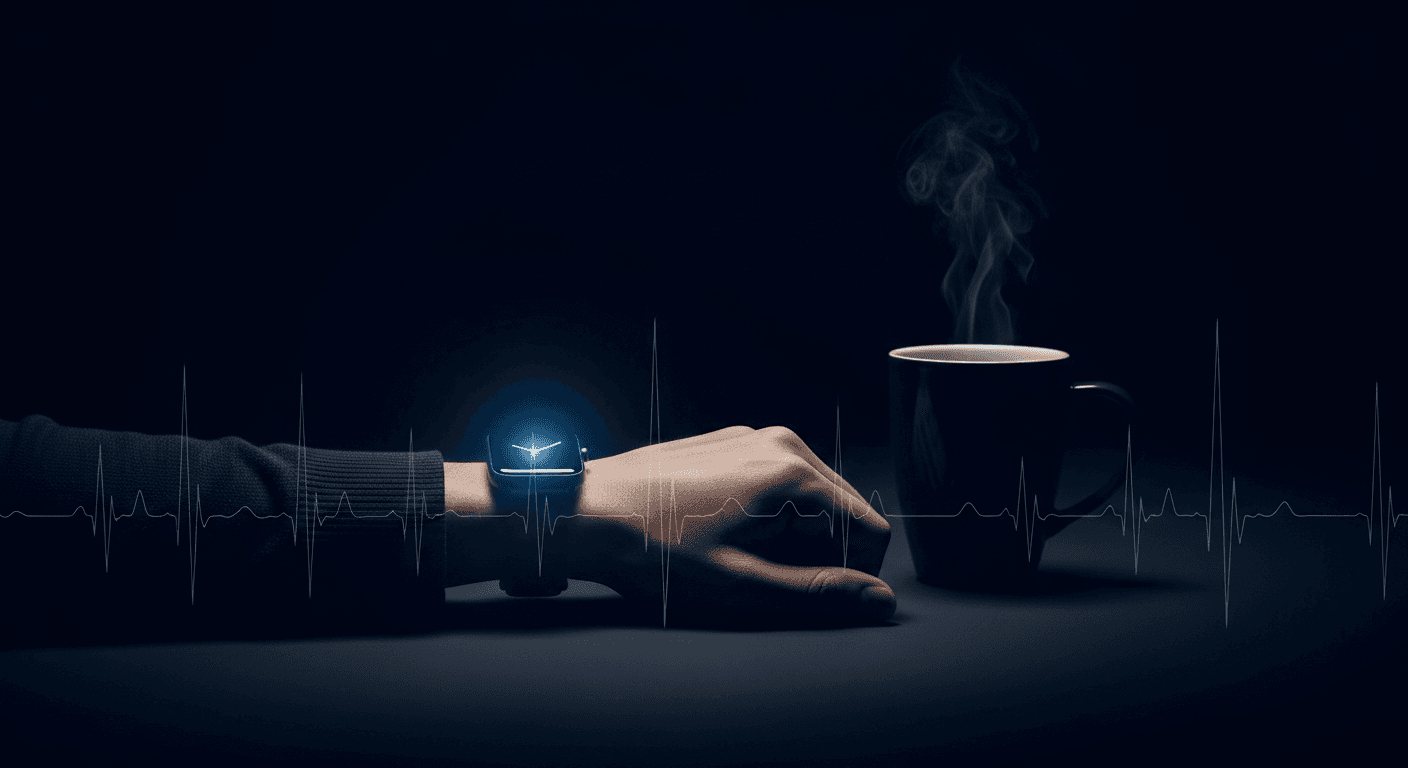
Biometric data overload doesn't lower stress. A system that reads the signal and acts on it does.


Most wearables assume the same thing: if they show you more, you'll do better. More resting heart rate, more HRV scores, more readiness percentages. The logic is that data drives behavior: see the problem, fix the problem.
The data says otherwise. Biometric data overload doesn't lower stress. In most cases it raises it. You end up with a second job, parsing your own body, and no clearer idea of what to do.
The failure sits in the design, specifically in how these devices decide what to hand you. Willpower never enters into it.
Biometric Data Overload Won't Lower Your Heart Rate
Here's the part the industry gets backwards. A number on a screen is not an intervention. It's a homework assignment.
Biometric data overload is what happens when a device collects far more physiological signal than it translates into action. HRV, heart rate, skin temperature, respiratory rate, sleep architecture, measured continuously and dumped on you at once. The industry solved collection years ago. It has barely started on translation.
Your nervous system doesn't read charts. It responds to inputs in real time. So when a device shows you a low HRV reading at 9 a.m., it has already missed the moment that mattered. The signal arrived. Nothing acted on it. You're left holding a fact about yourself and a vague instruction to "manage" it.
> A number on a screen is not an intervention. It's a homework assignment.
More resolution doesn't fix this. A sensor that samples at higher frequency produces a denser pile of the same unactioned data. The wearable market keeps competing on accuracy and breadth of metrics. Those are the wrong axes. The bottleneck sits after the sensor, in what the device does with everything it sees.
And there's a second cost nobody prices in. Watching a stress number is itself a stressor. The act of pulling up a readiness score, finding it low, and trying to figure out what to do about it triggers the exact sympathetic response the metric was supposed to help you avoid. The device measures the problem, surfaces the problem, and then becomes part of the problem. Any design that mistakes display for help ends up here, no matter whose logo is on the box.
The Read Is the Hard Part
There's a gap most devices never cross: the leap from raw signal to an actionable read. Collecting a heart-rate-variability stream is easy now. Knowing what it means for you, right now, in this context is the hard engineering problem. Almost no consumer device solves it.
Consider what a raw HRV number omits. It doesn't know you slept four hours. It doesn't know you're walking into a board meeting. It doesn't know that for your baseline, this exact reading at this time of day usually precedes a spike in forty minutes. Strip away that context and the number is close to meaningless. Showing it to you anyway, and calling it transparency, offloads the analysis onto the person least equipped to do it mid-day.
The difference between data about you and a system that reads you is the difference between a measurement and an interpretation: physiological signal cross-referenced against your patterns, your calendar, your context, and turned into a single decision. Act now, or don't.
That read is the entire product. Everything upstream of it is plumbing: the sensors, the sampling, the metrics. A device that floods you with biometric data overload and calls it insight has confused the plumbing for the water.
The hard part is also why most devices skip it. Crossing from signal to read requires the device to know your personal baseline, learn how your patterns shift across days, and weigh real-world context: what you're doing, where you are, what's on your calendar in the next hour. That's slow, individual, and unglamorous to build. It doesn't demo well at a keynote either. Far easier to ship one more metric and let the user sort it out. So that's what the market does. The result is a category of devices that are excellent at seeing and useless at deciding.
There's a reliability bar, too. A device that acts on its read has to be right, or at least right often enough that the wearer keeps trusting it. Misread the signal and nudge someone during an ordinary HRV dip, and you've spent attention you don't get back. Displays never face that test. A chart can stay ambiguous forever and nobody calls it broken; the interpretation was your job, so the miss was your fault. The moment a device makes the decision, its errors become visible and its accuracy becomes accountable. That accountability is what shipping another metric avoids, which tells you why the category keeps choosing metrics.
Biometric Data Overload Inverts Your Body's Design
Your body broadcasts constantly. Every few seconds it's emitting signal: cardiac, respiratory, thermal, hormonal. Far more than a conscious mind can follow, and that's by design. The autonomic system was built to run without you watching it.
So when a wearable hands all of that back to you and asks you to interpret it, it inverts the entire point. You were never supposed to manually process your own physiology. That's the work the system should absorb.
> You were never supposed to manually process your own physiology. That's the work the system should absorb.
Think about how good infrastructure handles this. Your phone doesn't show you every packet moving across the network. It shows you one bar of signal, or it connects the call. The intelligence lives in the layer that decides what's worth surfacing — and silently handles the rest. A wearable that surfaces everything has no intelligence layer at all. It has a sensor and a screen, with nothing in between making decisions.
This is why people abandon trackers within months. The data isn't wrong; it never resolves into anything. The chart goes up, the chart goes down, and the person is no steadier for any of it. A signal that demands constant interpretation is a tax on attention.
Notice what high performers want here. More visibility into their physiology isn't on the list; they have enough to think about. They want the thing handled. A founder heading into a 3 p.m. board meeting has no use for a readout on their cortisol curve. Walking in clear is the whole point. The metric is a means, and a bad device treats it like the end.
A System Should Make the Decision, Not the Wearer
The fix moves the decision off your plate and into the system. Cutting metrics for their own sake misses the point; a device with three numbers and no read is as useless as one with thirty.
A device should detect the rising signal, interpret it against everything it knows about you, and act — before you've consciously registered anything is wrong. No reading to decode. No score to react to. An early signal and a brief reset, delivered at the moment your nervous system needs it. The numbers stay under the hood, where they belong, doing their job without becoming yours.
That's the design principle behind Momomoon. It treats the read as the product. The signal goes in; an intervention comes out. Instead of a chart climbing toward a threshold, you get a single haptic nudge that says now, and a 1–2 minute reset that lands before the spike compounds. The intelligence does the parsing so your nervous system doesn't have to.
More data was never the answer. Ask what your wearable does with what it already sees.
Momomoon is the intelligence layer for your nervous system. It reads HRV and context signals from your Apple Watch, notices rising stress, and steps in with a 1–2 minute reset — before your day tips over. Free to download, and your first month of Momo is included.

Get new Journal entries when they’re published.
Field notes from the build. No marketing.