What "Multi-Signal" Stress Detection Actually Means
Multi-signal stress detection reads HRV, heart rate, sleep, motion, and temperature together — because one signal alone gets stress wrong.

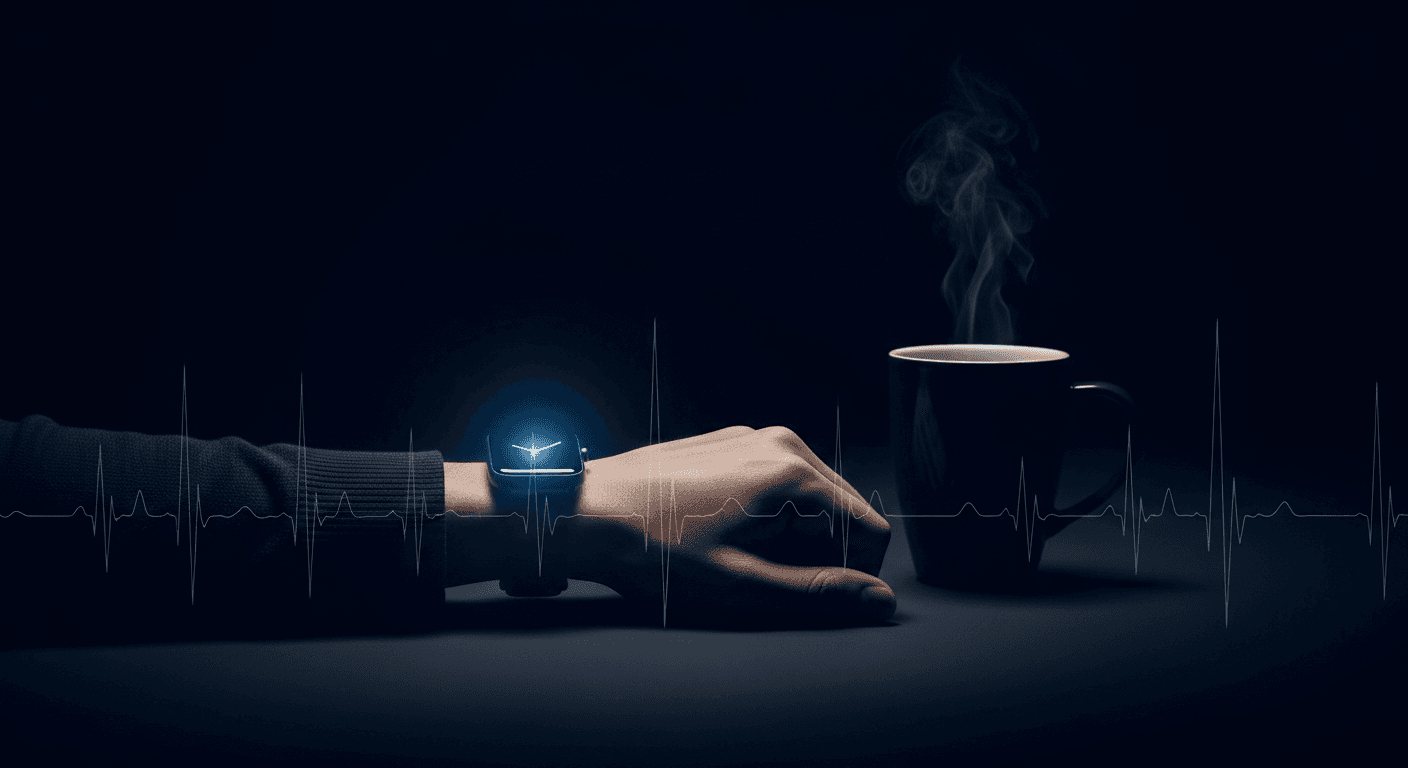
Your heart rate just jumped to 95. Are you stressed, or did you take the stairs?
A single number cannot answer that. This is exactly the problem multi-signal stress detection solves. Heart rate alone is one of the noisiest signals in the body. It spikes when you climb stairs, drink coffee, stand up too fast, or laugh hard at something. It also spikes when a deadline lands on your chest. From the outside, those moments look identical. The number is the same. The cause is not.
This is the core problem most wearables never solve. They watch one signal, see it move, and guess. Then they buzz your wrist and hope they got it right. Most of the time, they didn't.
Multi-signal stress detection takes a different approach, and the difference is mechanical, not cosmetic. It separates a device that reacts to noise from one that reads your nervous system. The rest of this piece is about how that read works, signal by signal, and why no single one of them can do the job alone.
What Multi-Signal Stress Detection Actually Means
Multi-signal stress detection is a method that reads several physiological inputs at once (HRV, heart rate, sleep, motion, and skin temperature) and cross-references them with real-world context like your calendar, location, and activity. No single signal triggers a response. The system looks for the combined pattern that means stress, not exertion.
That definition matters because it rules out a whole class of false alarms. A stress reading built on heart rate alone fires every time you move. A multi-signal read knows the difference between a hard climb and a hard conversation.
Here is the mechanism in plain terms. Each signal is unreliable on its own. But each one is unreliable in a different way. Heart rate is fooled by movement. HRV is fooled by hydration. Temperature drifts with the room. Because each signal fails for its own reasons, the failures rarely line up. When you combine them, those errors cancel out and the real signal stands up. It is the same logic engineers use everywhere: don't trust one sensor, trust the agreement between several. Aircraft do it with redundant altimeters. Anti-lock brakes do it with wheel-speed sensors that vote against each other. The principle is old and boring, which is why it holds up under real conditions.
Think of it like a server you're trying to keep alive. One metric, CPU load, tells you something is busy, but not whether it's a problem. Load plus memory plus request latency plus error rate, read together, tell you whether the box is fine or about to fall over. Stress detection works the same way. The single metric is suggestive. The combined pattern is the answer.
Every Signal Fails in a Different Way
Take HRV (heart rate variability), the tiny fluctuations in timing between heartbeats. HRV is the single best window into your nervous system. When you're calm, the gaps between beats vary a lot. When you're under load, they flatten out. Lower variability usually means your body has shifted into go-mode.
But HRV alone is fragile. It drops when you're stressed. It also drops when you're dehydrated, fighting a cold, digesting a heavy meal, or simply moving around. It even drifts with the time of day. Read HRV by itself and you'll mistake a workout for a panic spike, then read a panic spike as a normal afternoon. The signal is rich, but easy to misread in isolation. The best signal in the body still isn't enough on its own.
Now layer in the others. Motion tells the system whether you're sitting still or walking, so it can rule out exercise as the cause. If you're moving, an elevated heart rate is just effort. If you're dead still and your heart is racing, something else is driving it. Heart rate confirms the intensity of the shift. Sleep from the night before sets your baseline. A body running on four hours of sleep reacts harder to everything, so the same trigger that's harmless on Tuesday hits twice as hard on Thursday. Skin temperature shifts subtly as your nervous system redirects blood flow under stress. It's a quiet signal, but a real one.
None of these is the answer. Together, they triangulate it. When HRV drops, heart rate climbs, motion says you're still, and temperature shifts, that combination points one direction. It reads as stress, not exertion.
And the reverse is just as important. When HRV drops but motion says you're sprinting, the system stays quiet. It knows that's exercise, not strain. The signals don't only confirm stress. They rule it out when the cause is something else. That's what kills the false alarms. A one-signal device can't perform that subtraction, because it has nothing to subtract against.
Context Is the Second Sensor
Physiological signals tell you that something changed. They don't tell you why. Context closes that gap.
Your calendar knows you have back-to-back meetings from 2 to 5. Your location knows you're at the office, not the gym. Your activity history knows you run hot on Monday mornings. When the body signals a spike and the calendar says you just walked into a board review, the system isn't guessing anymore. It has the physiological evidence and the situational reason, and they line up.
This is what separates a real intervention from a random buzz. A wearable that only reads your wrist will nudge you mid-workout, mid-sprint, mid-laugh. You'll learn to ignore it within a week, and an alert you ignore is worse than no alert at all. It trains you to distrust the device. A system that cross-references your body against your day only speaks up when the signal and the situation both say stress. Fewer alerts. Higher trust. Every nudge earns its place.
Context also sharpens timing, not just accuracy. If the system knows a high-stakes call sits on your calendar at 4pm, it can weigh an early physiological shift more heavily as that hour approaches, because the situational risk is already there. The body's signal and the day's structure reinforce each other. Reading either one alone leaves half the picture on the table.
Context is not a nice-to-have feature bolted on top. It's a second sensor, one that reads the world instead of the body, and it makes the physiological read far more precise.
Multi-Signal Stress Detection Learns Your Normal
Here's the part most detection models skip: there is no universal stress signature. Your resting HRV is not mine. A heart rate of 80 might be elevated for one person and perfectly calm for another. A generic threshold, like "alert when HRV drops below X," will be wrong for almost everyone, because it was tuned for no one.
So the system builds a baseline from your data. Over the first stretch of use, it learns your normal: your typical HRV range, your usual resting heart rate, how your numbers move across a day, how Tuesday differs from Saturday. Stress shows up as a deviation from your own pattern. A fixed number can't capture that.
This is why detection sharpens over time. Week one, the system works from population averages, a reasonable starting guess but still a guess. By week four, it knows that your 11pm heart rate creep means tomorrow will be rough, or that your HRV dips before every flight, or that your numbers run hot for an hour after lunch and that's just normal for you. The longer it runs, the more personal and accurate the read becomes. A static threshold can't do this; a baseline that learns you can.
There's a compounding effect here that's easy to miss. Every signal the system reads becomes training data for the next read. The more it sees your real days (the meetings, the workouts, the bad nights) the better it gets at telling them apart. Accuracy here behaves like a curve that bends upward the longer you wear the device, not a fixed spec you ship once. That's only possible because the system reads enough signals to learn from in the first place. One number gives it almost nothing to learn from. Five give it a model of you.
Good Sensors Can't Fix Bad Logic
It's worth being blunt about why most stress tracking feels useless. The problem isn't the hardware. The sensors are good. The logic sitting on top of them is where it breaks.
A one-signal model has to choose between two bad outcomes. Set the threshold low and it fires constantly. Every coffee, every staircase, every excited moment gets flagged as stress. Set it high and it misses the quiet, compounding stress that never produces a dramatic spike but grinds you down across a day. There is no setting that works. One signal can't tell the difference between exertion and strain, and no amount of tuning fixes that.
This is the trap, stated plainly: a single signal forces a choice between too many false alarms and too many misses. Both failures train you to stop trusting the device. And the quiet misses are the dangerous ones. The slow Monday that never spikes but leaves you fried by 6pm is exactly the stress worth catching, and exactly the stress one signal is blindest to. The dramatic spike takes care of itself. You can feel it. The kind that compounds underneath your awareness is the kind a real detection system has to earn its keep on.
Multi-signal detection escapes the trap by asking five questions at once and only acting when the answers agree. That redundancy is the whole point. It's the difference between a smoke detector that screams every time you make toast and one that knows the difference between toast and a fire.
This is the detection moat. Anyone can read a heart rate. Reading HRV, heart rate, sleep, motion, and temperature together, then cross-referencing them against your calendar, your location, and a baseline learned from your own body, is a different engineering problem entirely. It requires fusing signals that arrive at different rates, with different noise, and reconciling them into one decision in real time. It's harder to build, and it's the only version that earns the right to interrupt you. That difficulty is the point. A read this hard to fake is what separates a real intervention system from another wrist-buzzer.
Detection Isn't the Goal. It's the Prerequisite.
The reason accuracy matters so much is that everything downstream depends on it.
If the read is right, the intervention can be early. Momomoon uses this multi-signal read to catch rising stress before it fully lands, then delivers a brief haptic reset on the watch, running on Apple Watch during the beta. No screen. No dashboard. Just a nudge at the moment the signal and the situation both confirm you need one.
But that early nudge is only useful if it's correct. Interrupt someone mid-workout and you've trained them to ignore you. Catch the real spike, the one before a hard meeting, the one building under four hours of sleep, and you've earned a place in their day. Accuracy is what makes intervention welcome instead of annoying. Multi-signal detection is how you get there.
This is also why the order matters. You can't intervene well on a read you don't trust. Every wearable that buzzes at the wrong moment is paying for a detection model that was too simple. Get the read right first (multiple signals, real context, a baseline tuned to you) and the intervention almost designs itself. A brief reset, delivered at the one moment your body and your day agree you need it. No screen. No metric to interpret. Just a signal you can act on, because the system did the hard work of being sure before it spoke.
That's why one signal isn't enough. Stress doesn't show up as a single clean number. It shows up as a pattern across your body and your day, and the only way to read a pattern is to read all of it at once.
Momomoon is the intelligence layer for your nervous system. It reads HRV and context signals from your Apple Watch, notices rising stress, and steps in with a 1–2 minute reset — before your day tips over. Free to download, and your first month of Momo is included.

Get new Journal entries when they’re published.
Field notes from the build. No marketing.